
Odisha Vikash Conclave 2025 Calls for Climate-Ready Development
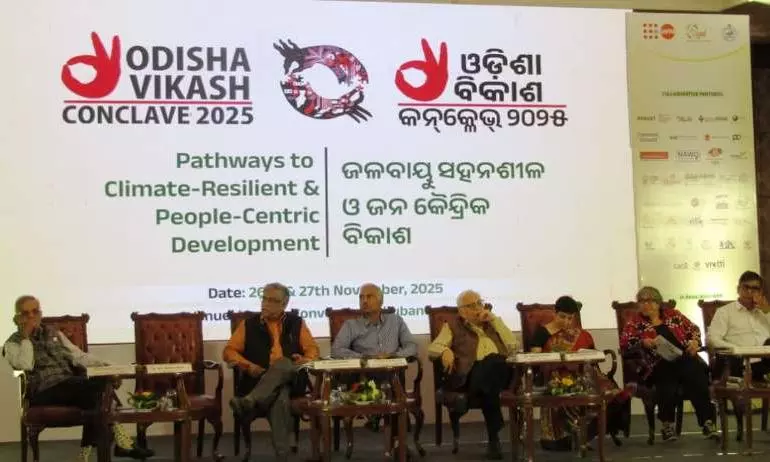
Chief Secretary stresses decentralised planning and stronger partnerships as Odisha prepares for climate risks, livelihood shifts and demographic change.
Bhubaneswar: Odisha must chart its next decade of development through deeper collaboration and stronger community participation, Chief Secretary Manoj Ahuja said while inaugurating the 6th Odisha Vikash Conclave (OVC) 2025. Addressing policymakers, experts and civil society representatives, Ahuja emphasised that the state’s emerging challenges—ranging from climate vulnerability to shifting livelihood patterns—demand solutions that begin at the grassroots.
He noted that decentralised, community-driven systems, especially those led by Self-Help Groups (SHGs) and local institutions, will be critical in improving last-mile service delivery. “When communities guide planning, we create stronger livelihoods and reduce distress migration,” he said, urging closer coordination between government departments, civil society organisations, academia, and markets.
Setting the tone for the two-day event, Jagadananda, Co-founder of Odisha Development Initiative and CYSD, said that OVC 2025 places “Balanced Development and Climate Resilience” at the heart of Odisha’s development vision. He stressed that forests, coasts, wetlands, livelihoods, governance, technology and social protection are interlinked. “Odisha needs holistic, integrated solutions that treat communities as partners—not passive beneficiaries,” he said.
The sessions also delved into the twin realities of climate transition and Just Transition for mineral-dependent regions. Srestha Banerjee, Director of iFOREST, pointed out that the recently concluded COP30 has placed Just Transition firmly on the global agenda. For Odisha, she said, this means ensuring that workers and communities in coal-bearing and resource-rich districts are protected as the state moves towards cleaner energy pathways. “A people-centred transition is non-negotiable,” she added.
Demographic change emerged as another major theme. Md. Nadeem Noor, UNFPA Odisha State Head, highlighted that Odisha’s total fertility rate has dipped to 1.6—below replacement level—and the state may enter a “net mortality zone” by 2041. With life expectancy rising and disability prevalence also increasing, Noor underscored the need for reimagined governance, public health systems and social protection measures suited for an ageing population.
The 2025 Conclave features 15 thematic sessions across five broad pillars: ecosystem protection, just transitions, resilient governance, vulnerability reduction and social leadership. The discussions are expected to culminate in the release of an Odisha Climate & Development Policy Brief, along with a compilation of community-led, climate-resilient solutions that can be scaled across districts.
As Odisha stands at a critical juncture—balancing growth ambitions with climate realities—the Conclave aims to shape a roadmap that is people-centred, future-ready and grounded in local wisdom.